PhD in Denmark 2026: Salary, 5+3 and 4+4 Programmes
Learn how paid PhD fellowships in Denmark work, including salary, the 5+3 and 4+4 routes, eligibility, documents and applications for international candidates.
Graduates Corner Team
Editorial standardsPhD in Denmark: quick answer
Yes, a PhD in Denmark is usually paid. Most PhD students are employed as PhD fellows on a salaried, three year contract under the collective agreement between the Danish state and the academic unions.
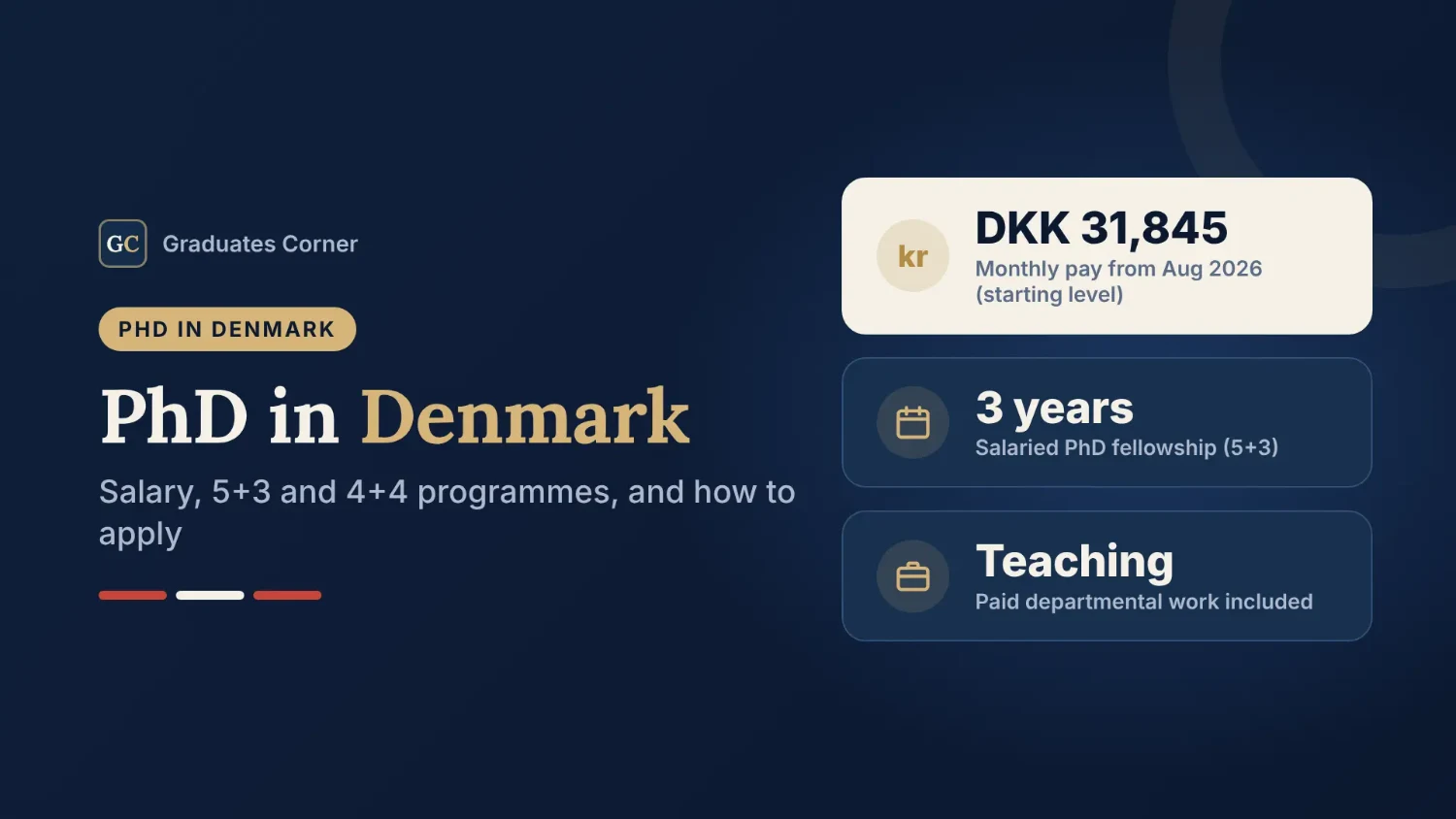
Duration: 3 years for Master's graduates (the 5+3 model)
Salary example: at Aarhus University, monthly pay from 1 August 2026 is about DKK 31,845 at the starting level (base salary plus a PhD bonus), and higher with relevant work experience
Other route: the 4+4 model, where you start the PhD before finishing your Master's
Duties: PhD fellows usually do departmental work, such as teaching, as part of the job
Open to: international candidates, including students from Pakistan, India and Africa
How does a PhD in Denmark work?
In Denmark, PhD students are usually called PhD fellows or PhD students, and most are employees of the university. You are paid a monthly salary and work on your research project, take PhD courses, spend time at another research environment (often abroad), and help with teaching or other departmental duties.
PhD positions are normally advertised by universities, either as project positions or through open calls run by graduate schools.
What is the difference between 5+3 and 4+4 PhD programmes in Denmark?
5+3 model (most common for international applicants):
You already have a Master's degree (5 years of university study)
You do a 3 year PhD as a salaried PhD fellow
4+4 model:
You start the PhD after about one year of your Master's
Part A (about 2 years): you finish your Master's while starting PhD work. At Aarhus University, Part A students receive two SU grants per month (DKK 7,426 per grant in 2026) plus pay for working hours
Part B: after the Master's degree and a qualifying exam, you are employed on the same terms as a 5+3 PhD fellow
How much does a PhD student earn in Denmark?
PhD salaries follow the national agreement for academics in the state sector, so they are similar across Danish universities. Your salary level depends on your relevant work experience after your Master's.
Example: Aarhus University, monthly pay from 1 August 2026 (5+3 PhD fellows)
Level 4: DKK 30,264.08 base salary, DKK 31,845 in total with the PhD bonus
Level 5: DKK 32,617.08 base salary, DKK 34,198 in total
Level 6: DKK 34,763.00 base salary, DKK 36,343.92 in total
Level 8: DKK 36,877.72 base salary, DKK 38,458.64 in total
The PhD bonus is DKK 1,580.92 per month. Pension contributions are added on top of the base salary according to the agreement. Danish income tax is high, so net pay is noticeably lower than gross.
What duties does a PhD fellow have in Denmark?
Besides your research and courses, you usually do paid departmental work, such as teaching, supervising students or assisting with research activities. At Aarhus University, the guideline for paid departmental work is 840 hours in total during the PhD.
Most Danish PhD programmes also include:
PhD courses (often about 30 ECTS)
A stay at another research institution, often abroad
Dissemination of your research
Who can apply for a PhD in Denmark?
Typical requirements for a 5+3 PhD fellowship:
A Master's degree (or equivalent) in a relevant field
Strong English skills, as most PhD programmes in Denmark use English
A good match with the project or research group
Any specific skills in the job ad
International students are welcome, including candidates from Pakistan. Non-Danish fellows from outside the EU need a residence and work permit before their employment can start.
How to apply for a PhD in Denmark (step by step)
Step 1: Search for PhD positions. Look at the job pages of Danish universities such as the University of Copenhagen, Aarhus University, Technical University of Denmark (DTU), Aalborg University, University of Southern Denmark (SDU), Copenhagen Business School, Roskilde University and IT University of Copenhagen. You can also browse openings on the Graduates Corner PhD positions page.
Step 2: Choose project or open call. Some positions are linked to a specific project. Others are open calls where you submit your own research proposal.
Step 3: Prepare your application. Usually a CV, motivation letter, degree certificates and transcripts, references and, for open calls, a research proposal.
Step 4: Submit and interview. Shortlisted candidates are interviewed, often online. An assessment committee may evaluate your qualifications.
Step 5: Enrolment and permit. If selected, you are enrolled in the graduate school, sign your employment contract, and apply for a residence and work permit if needed.
Should I contact a professor before applying for a PhD in Denmark?
For project positions, it is a good idea to email the contact person in the ad with any questions. For open calls, you often need a supervisor who supports your proposal, so contacting a potential supervisor early is strongly recommended.
Ask about both supervision and funding:
"Are there any funded PhD positions in your group, or would you recommend a relevant funding route?"
Tips to get a funded PhD in Denmark
Match the project closely. Danish PhD calls are competitive and very specific.
Write a strong motivation letter that connects your Master's work with the project.
For open calls, write a focused proposal with a clear question, methods and timeline.
Show teaching or communication skills, since departmental work is part of the job.
Apply early and to several universities.
Key takeaways: PhD in Denmark
A PhD in Denmark is usually a paid three year job (5+3 model).
Salaries follow a national agreement. Aarhus University's August 2026 scale starts at about DKK 31,845 per month including the PhD bonus.
The 4+4 model lets you start before finishing your Master's.
Departmental work, such as teaching, is part of the PhD.
International students, including Pakistani candidates, can apply.
Frequently asked questions
Is a PhD in Denmark paid?
Yes. Most PhD students in Denmark are employed as PhD fellows with a monthly salary under the state's collective agreement for academics.
How much does a PhD student earn in Denmark?
At Aarhus University, from 1 August 2026, monthly pay for a 5+3 PhD fellow starts at about DKK 31,845 including the PhD bonus, and rises with relevant work experience.
How long is a PhD in Denmark?
Three years for students with a Master's degree (the 5+3 model). The 4+4 model combines the last part of the Master's with the PhD.
What is the 4+4 PhD model in Denmark?
It lets you start a PhD after about one year of your Master's. You finish your Master's in Part A and become a salaried PhD fellow in Part B.
Can international students do a PhD in Denmark?
Yes. International candidates, including students from Pakistan, can apply. Non-EU fellows need a residence and work permit before starting.
Do PhD students teach in Denmark?
Usually yes. PhD fellows do paid departmental work such as teaching. At Aarhus University the guideline is 840 hours in total.
Where can I find PhD positions in Denmark?
On the job pages of Danish universities such as Copenhagen, Aarhus, DTU, Aalborg and SDU, and on the Graduates Corner PhD positions page.
Official sources and further reading
Aarhus University, PhD salary and employment: https://phd.arts.au.dk/financing/salary-and-employment/
Danish immigration service, residence and work permits: https://www.nyidanmark.dk
Find current PhD positions on Graduates Corner: https://graduatescorner.com/phd-positions
Information checked on 16 October 2026. Salaries are adjusted regularly and rules differ between graduate schools, so always confirm on the official website before applying.
#PhDinDenmark #PhD #FundedPhD #PhDFellowship #StudyInDenmark #PhDJobs #PhDStudent #ResearchInDenmark #AarhusUniversity #DTU #GraduatesCorner