
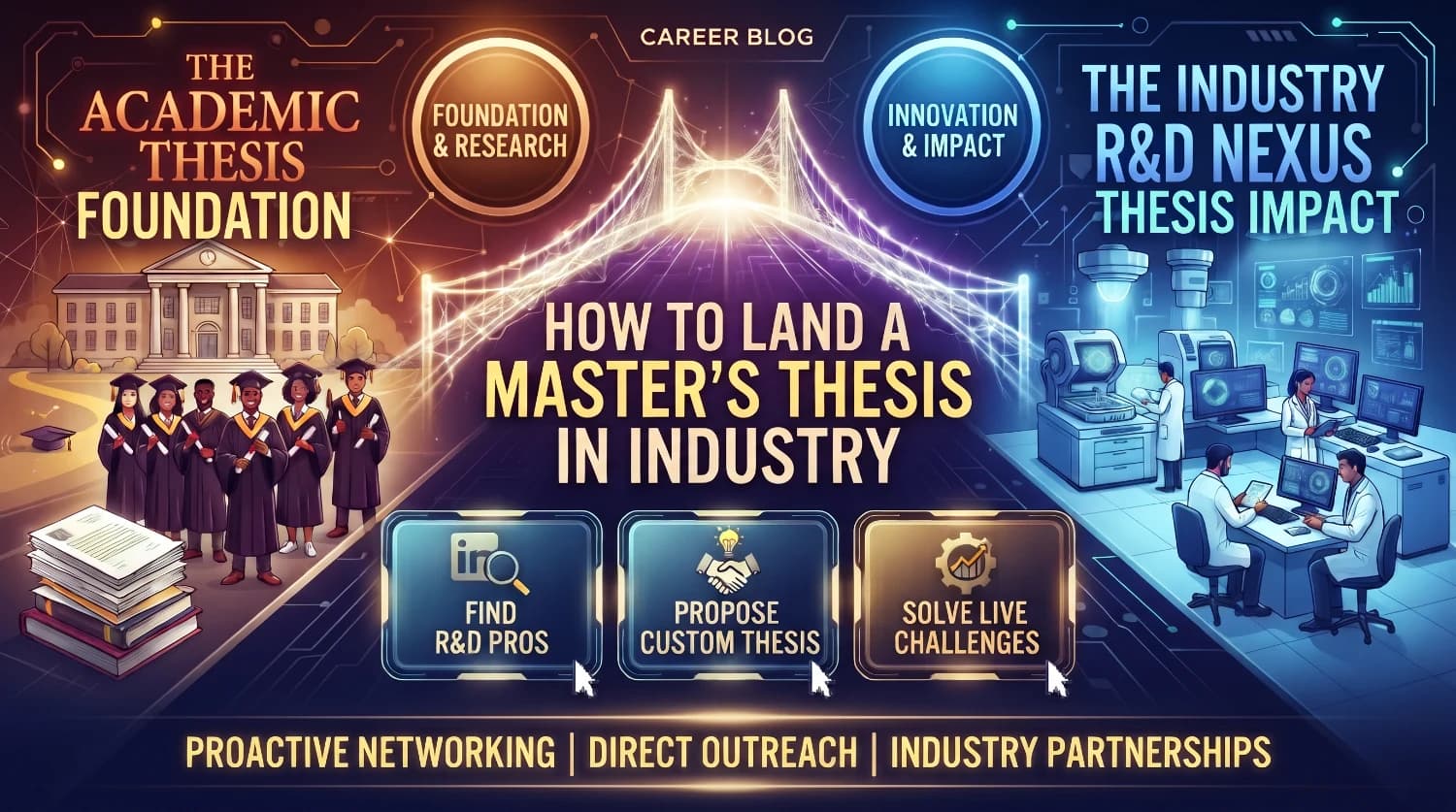
How to Land a Master's Thesis in Industry: A Step-by-Step Guide to Proactive Networking and Direct Outreach
Graduates Corner Team
Author
Introduction
Writing your Master's thesis in an industrial setting rather than locked inside an academic bubble can be a massive game-changer for your career. An industry thesis allows you to solve real-world engineering or business problems, build a professional network, and often leads directly to a full-time job offer after graduation.
However, waiting for companies to post thesis positions on job boards means competing with hundreds of other applicants. The secret weapon? Creating your own opportunity.
In this guide, we will break down proven, proactive strategies to approach industry professionals, pitch your ideas, and land the ideal industry-sponsored Master's thesis.
Why an Industry Thesis Beats a Traditional Academic Thesis
Before jumping into the strategies, let's look at why industrial theses are so sought after:
Real-World Impact: You work on live, practical challenges faced by companies instead of theoretical models.
Industry Networking: You collaborate daily with R&D engineers, managers, and directors.
Direct Employment: Many companies use the Master's thesis as a 6-month trial period to evaluate candidates for permanent engineering or research roles.
Financial Compensation: Unlike many academic projects, industry theses are frequently paid or come with a generous monthly stipend.
Strategy 1: The LinkedIn R&D Outreach Blueprint
Most major companies do not advertise all their internal thesis topics publicly. R&D departments often have backlog projects they want to explore but lack the dedicated manpower. This is where you step in.
Step 1: Identify Your Target Companies
Make a list of 15 to 20 companies in your field (e.g., automotive, renewable energy, AI, robotics, or biotech) that have active R&D hubs or innovation centers.
Step 2: Find the Right People
Do not message HR or general recruitment emails; they will likely route you to standard job postings. Instead, use LinkedIn search filters to find:
R&D Engineers
Senior Research Scientists
Innovation Managers
Head of Engineering / Technology Leads
Step 3: Send a Personalized Connection Request
Never send a blank connection request. Keep it brief and professional.
"Hi [Name], I’m an upcoming Master’s student specializing in [Your Field] at [Your University]. I’ve been following [Company Name]’s pioneering work in [Specific Technology] and would love to connect."
Strategy 2: Proposing a Thesis via the "Problem-Solving" Approach
Once they accept your connection, do not immediately ask for a job or a thesis. Build a quick rapport, then pitch your value using one of two winning approaches:
Approach A: The Active Challenge Proposal
If you notice through their blog posts, whitepapers, or product announcements that they are tackling a specific technical hurdle, offer a solution framework.
The Message Structure:
"Hi [Name], thanks for connecting! I’ve been analyzing recent developments in [Topic], and I noticed your team is working on [Specific Challenge]. For my upcoming Master’s thesis, I am planning to research [Your Proposed Solution/Methodology]. Would your R&D team be open to a quick 10-minute chat next week to see if this aligns with any internal challenges you are currently facing?"
Approach B: The Open Inquiry Strategy
If you don't have a specific project in mind, ask if they have open-ended research backlog items.
The Message Structure:
"Hi [Name], I am currently looking for an industrial home for my Master’s thesis starting in [Month]. I specialize in [Your Core Skills, e.g., Machine Learning, Embedded Systems, Material Testing]. Does your R&D or engineering department currently have any exploratory research challenges or internal projects that a dedicated Master’s student could take ownership of over the next 6 months?"
Strategy 3: Leverage University-Industry Partnerships and Professors
Your university professors are deeply embedded in industrial networks.
Talk to Thesis Coordinators: Ask professors which companies regularly sponsor student research.
Check Alumni Networks: Look up alumni from your university on LinkedIn who are currently working as senior engineers in target companies. Alumni are much more likely to respond and advocate for students from their alma mater.
Best Practices for a Successful Pitch
Keep Your CV / Portfolio Ready: Have a clean, 1-page CV highlighting technical projects, coding skills, simulation software, or lab experience. If you have a GitHub profile or a personal portfolio website, link it.
Be Flexible: Sometimes companies like your profile but want to tweak the project scope to fit their current roadmap. Be adaptable.
Handle Logistics Early: Be prepared to discuss confidentiality agreements (NDAs) and intellectual property rights, as companies will want to protect their proprietary data.
#MasterThesis #IndustryThesis #EngineeringStudents #ResearchAndDevelopment #CareerAdvice #JobSearchStrategies #StudentNetworking #HigherEducation #MastersDegree #StudyAbroad #EngineeringCareers